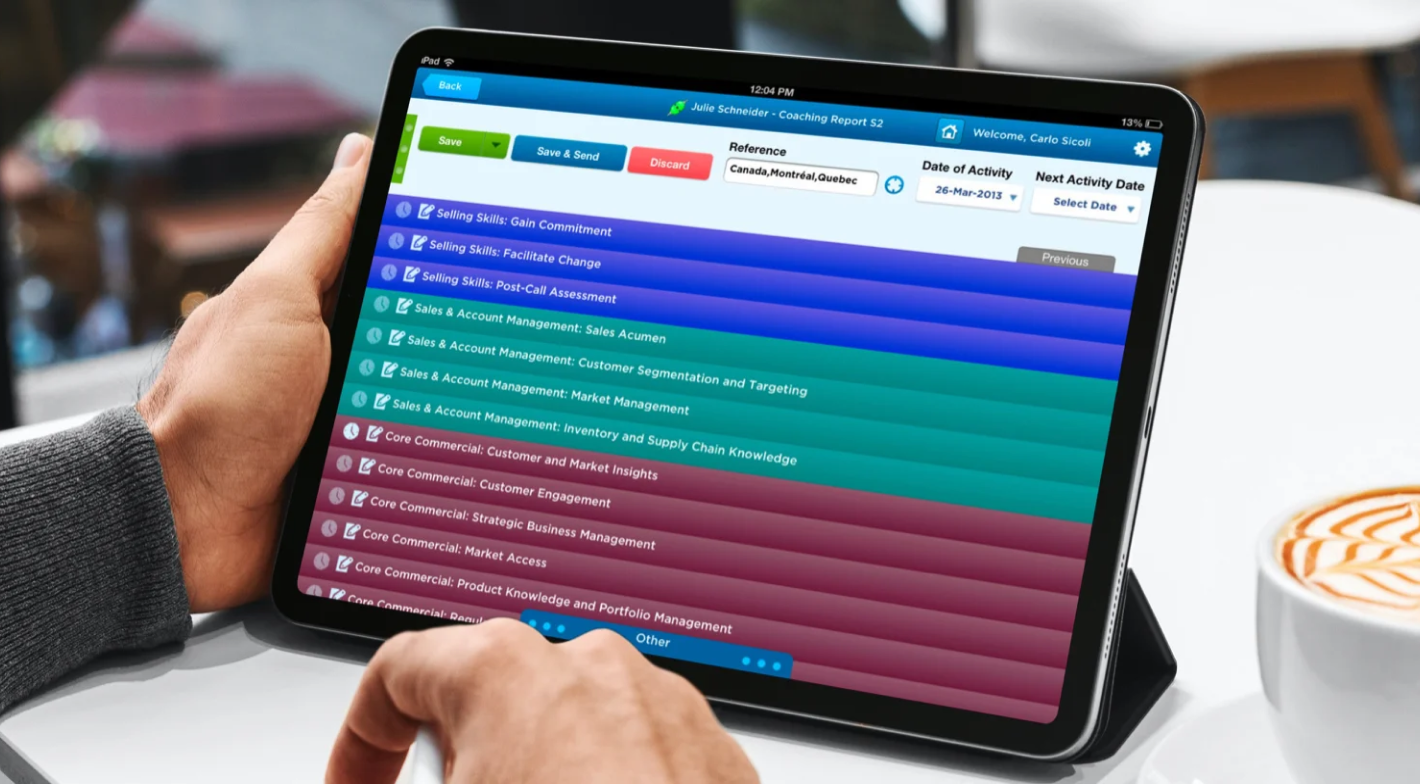
IsaiX builds coaching technology for organizations where field performance is tied directly to revenue and regulatory compliance. Its flagship platform, Coach 5, is used by pharmaceutical and financial services enterprises to observe field representatives, score competencies, and turn each observation into a tracked development plan.
The previous generation of the product, Coach 4, worked well for a small set of similar clients and then stopped scaling. Its evaluation forms were fixed, so every organization had to adopt the same coaching model. Its permission model was flat, so it could not represent matrix reporting structures where a coach spans product lines, regions, and business units. It had no mobile experience, so a mentor visiting a remote branch or an overseas site lost hours of work to connectivity gaps. And it lacked the tenant isolation and single sign-on that enterprise procurement teams treat as non-negotiable.
Net Solutions re-engineered Coach 5 from the domain model up. We built a configurable workflow engine so each client defines its own scorecards, competencies, and sign-off chains without custom code. We added hybrid role and attribute-based access control so annual reorganizations become reassignments rather than rebuilds. We shipped native iOS and Android apps that let coaches complete full assessments offline and sync automatically on reconnection. And we put the whole platform on a secure multi-tenant foundation with federated identity, so a new enterprise can onboard using its own corporate credentials from day one.
The result is a platform that no longer dictates how an organization coaches, and no longer breaks when the organization changes shape.
IsaiX had accumulated deep coaching expertise and wanted to productize it: to let other enterprises run their own methodologies on the platform rather than adopt IsaiX’s. Coach 4 could not support that ambition. Five constraints stood in the way.
Evaluation forms, data collection templates, and approval chains were fixed in the application. A pharmaceutical sales organization and a retail banking network were forced into identical scorecards, even though their competency frameworks had almost nothing in common. The software dictated the coaching style instead of supporting it.
Real enterprises are matrixed. A coach may evaluate representatives across two product lines and three territories, while reporting into a regional director who reports into a functional lead. Coach 4’s single reporting tree could not express this, so administrators resorted to duplicate accounts and manual workarounds that broke every time the org chart changed.
Regulated clients in pharma and banking required provable data segregation between organizations and strict user-level access boundaries. The legacy architecture could not demonstrate this, which stalled deals during security review.
The highest-value coaching happens in the field: a ride-along with a sales rep, a branch visit, a site observation. Those are exactly the places with weak or no connectivity. With no mobile app and no offline mode, coaches took notes on paper and re-entered them later, often days later, with detail loss along the way.
Enterprise clients who had validated a specific configuration did not want to be moved onto a new release on the vendor’s schedule, particularly in regulated environments where change control is expensive.
The scenario that shaped the architecture: A coach flies out and runs sessions for two months with intermittent internet. While they are away, their organization restructures and the platform ships two updates. When they reconnect, every evaluation they recorded must land intact, under the right hierarchy, on the version their tenant is running. The system had to absorb all three changes without thinking about any of them.
We treated enterprise friction as an architectural problem rather than an operational one.
The core decision was to stop modeling coaching as a static administrative record and start modeling it as something that happens in motion: across locations, across reporting lines, and across time. If the platform natively understands intermittent connectivity, matrix hierarchies, and version divergence, then there are no gaps to reconcile downstream. Continuity replaces cleanup.
Three principles shaped the build:
Around those principles, we engineered a secure multi-tenant cloud foundation with federated identity management and centralized governance across every global tenant.
Rather than restyling screens, we rebuilt the domain model. Nine pillars define the platform.
Multi-tenancy is the foundation of the system, not a layer on top of it. Role trees, attributes, modules, and configuration are defined independently per tenant, so no two client organizations share structural definitions. Five core role types (admin, client, coach, coachee and manager) govern what each user can see and act on, which keeps reporting data cleanly scoped and lets action plans route to the right people automatically. This isolation is what allows the platform to clear security review in highly regulated industries.
Coach 5 integrates with a client’s existing identity store through a federated identity management layer using IP-STS and RP-STS token services. New enterprises do not migrate user directories to onboard. Employees sign in with the corporate credentials they already use, which removes the single largest source of rollout friction and eliminates a parallel set of passwords for IT to manage.
Organizations build their own evaluation forms, define their own coaching lifecycles, and map the platform to their own methodology. Branch scorecards, competency ladders, and pipeline-linked coaching flows are all configuration, not code. Clients can also relabel the interface in their internal terminology, so the platform speaks the language the workforce already uses. Adoption improves when the software looks like something the organization built.
To absorb annual reorganization churn, access control is multi-dimensional. A traditional role hierarchy is combined with attributes such as region, product, and sales force. A role granted a higher-level attribute automatically inherits everything beneath it, which eliminates role duplication and handles cross-departmental coaching teams without bespoke configuration. When the org chart changes, administrators reassign attributes instead of rebuilding permission structures.
Native iOS and Android apps give coaches the full evaluation experience in the field. They can run assessments, capture notes, and complete forms with no connectivity. When the device detects a connection, the platform securely syncs and uploads everything to the cloud. Coaches stop managing the gap between observation and record, and no assessment data is lost between the two.
Integrated video calling supports hybrid and remote teams. A coach can run a live remote session inside the application while documenting the evaluation and referencing historical performance data in the same view, which brings desk-based and field-based coaching onto one record.
Coaching only matters if something changes afterwards. Managers assign specific action plans coming out of an evaluation, and those plans are tracked to completion. Each observation produces clear next steps with owners and status, which turns a one-off assessment into a continuous feedback loop.
Default cultures and languages are set at the tenant level, and individual users select their own preferred language. A single global enterprise can serve cross-border teams natively without operating separate deployments per region. A tenant could create their own translations for UI and Messages. This facilitated easy understanding and adoption of applications.
Tenants satisfied with their current release are not pushed onto the next one. We architected this with feature flags, tenant-to-version mapping, and version-aware API and database routing. When a release genuinely requires a schema or API signature change, the tenant is moved by the smallest possible version jump, which keeps migrations low-risk and predictable for change-controlled environments.
Above the individual coaching record sits a unified dashboard that consolidates coaching summary, distribution, allocation, and competency level reporting into a single view. Second-line leaders get a top-down picture of coaching activity and outcomes, which lets them see who needs support and where to direct resources.
Coach 5 launched into enterprise adoption and gave IsaiX a product line built to keep evolving.
Hybrid RBAC absorbs annual restructures, turning what used to be a permissions rebuild into a set of attribute reassignments.
Multi-tenant data isolation and federated identity satisfy the compliance requirements of pharmaceutical and financial services buyers, opening markets the legacy product could not enter.
Offline-first mobile removes the connectivity dependency from the most valuable coaching moments, and automatic sync means no assessment is lost between the field and the system of record.
New tenants go live on their own corporate credentials, which shortens implementation timelines and removes a recurring IT objection.
Aggregated dashboards give second-line managers the roll-up view they never had, linking coaching activity to business outcomes.
Multi-version support lets regulated tenants stay on a validated release, which removes a common source of enterprise renewal friction.
Coach 5 is deployed across enterprises including Bayer, Merck, Daiichi Sankyo, and Toronto-Dominion Bank.
Coach 4 had earned its market position. The job was not to replace what worked, it was to rebuild the architecture underneath it so the product could go where the business wanted to go.
We approached it as a domain modeling problem: separating identity from position, methodology from software, and work from network availability. Comprehensive documentation ran alongside mobile-first development, so the platform was usable by client organizations from launch rather than after a stabilization period.
If you have a platform that customers value and an architecture that has stopped keeping up, that is the problem we solve. Let’s talk about yours.
Coach 5 is a multi-tenant SaaS coaching platform built by IsaiX for enterprise workforce development. It lets organizations run structured field coaching, score competencies against their own evaluation frameworks, assign trackable action plans, and monitor coaching outcomes through manager dashboards. Net Solutions re-engineered it from the legacy Coach 4 application into a configurable, mobile-first, multi-tenant product used by enterprises including Bayer, Merck, Daiichi Sankyo, and TD Bank.
Coach 4 had hard-coded evaluation workflows, a flat reporting hierarchy that could not represent matrix organizations, no mobile or offline capability for field coaches, and insufficient tenant isolation for regulated enterprise buyers. Those limits blocked IsaiX from selling the platform to organizations with different coaching methodologies and stricter compliance requirements, so the architecture was rebuilt rather than patched.
Coaches use native iOS and Android apps to run complete evaluations, capture notes, and fill in forms with no internet connection, which matters because field coaching often happens in remote branches, client sites, and travel settings. When the device detects connectivity, the platform securely syncs and uploads all captured data to the cloud automatically, so nothing depends on the coach remembering to re-enter records later.
Hybrid RBAC combines a traditional role hierarchy with attribute-based access control using dimensions such as region, product, and sales force. It is needed because enterprise coaching crosses reporting lines: a coach may evaluate representatives across several territories and product groups at once. In Coach 5, a role granted a higher-level attribute automatically inherits everything beneath it, so corporate reorganizations are handled by reassigning attributes rather than rebuilding permission structures or duplicating roles.
Multi-tenancy is built into the core domain model. Role trees, attributes, modules, and configuration are defined independently per tenant, and four core role types (admin, client, coach, and manager) enforce access boundaries within each one. This structural segregation is what allows the platform to satisfy the data isolation requirements of regulated pharmaceutical and financial services clients during security audits.
Yes. Coach 5 uses a federated identity management layer with IP-STS and RP-STS token services to integrate with a client’s existing identity store. Employees sign in with their existing organizational credentials, so onboarding a new enterprise does not require migrating user directories or issuing a separate set of passwords.
Yes. Coach 5 includes a configurable workflow engine that lets each organization create its own evaluation forms, define its own coaching lifecycle and sign-off chains, and adapt the platform to its training methodology without custom development. Clients can also rename interface labels and messages to match their internal terminology, which makes adoption easier for the workforce.
No. Coach 5 supports multiple concurrent versions using feature flags, tenant-to-version mapping, and version-aware API and database routing. A tenant that is satisfied with its current release can stay on it. When a change genuinely requires a database or API signature update, the tenant is migrated with the smallest possible version jump to keep the change low-risk.
Second-line managers get an aggregated dashboard that consolidates coaching summary, distribution, allocation, and competency level reporting into a single view. This gives leadership a top-down picture of coaching activity across teams so they can identify who needs support and prioritize where to invest coaching resources.
Net Solutions re-engineered the Coach platform into Coach 5, delivering the multi-tenant architecture and data segregation model, the federated identity integration, the configurable workflow engine, hybrid role and attribute-based access control, native iOS and Android apps with offline capture and automatic sync, in-app video coaching sessions, action plan tracking, multi-language support, multi-version tenant routing, and aggregated manager dashboards.
Timelines depend on how much of the domain model has to change. A re-skin is measured in weeks, while a rebuild that separates tenancy, identity, and workflow configuration, as Coach 5 did, is a multi-phase engagement typically scoped over several months with functionality released incrementally. Net Solutions scopes this after an architecture and product discovery assessment. Get in touch to discuss your platform.
Coach 5 went from a single-methodology tool to enterprise SaaS without losing what its users valued. Tell us where your platform is hitting its limits, and we'll tell you what a rebuild would actually involve.
Results matter. Discover how our customized solutions have delivered measurable business outcomes for clients across various industries. Each case study highlights the strategic impact of our work, turning challenges into opportunities for growth.
Ask Sol anything about digital products, AI, engineering, or growth, and get answers drawn from years of Net Solutions thinking and experience.