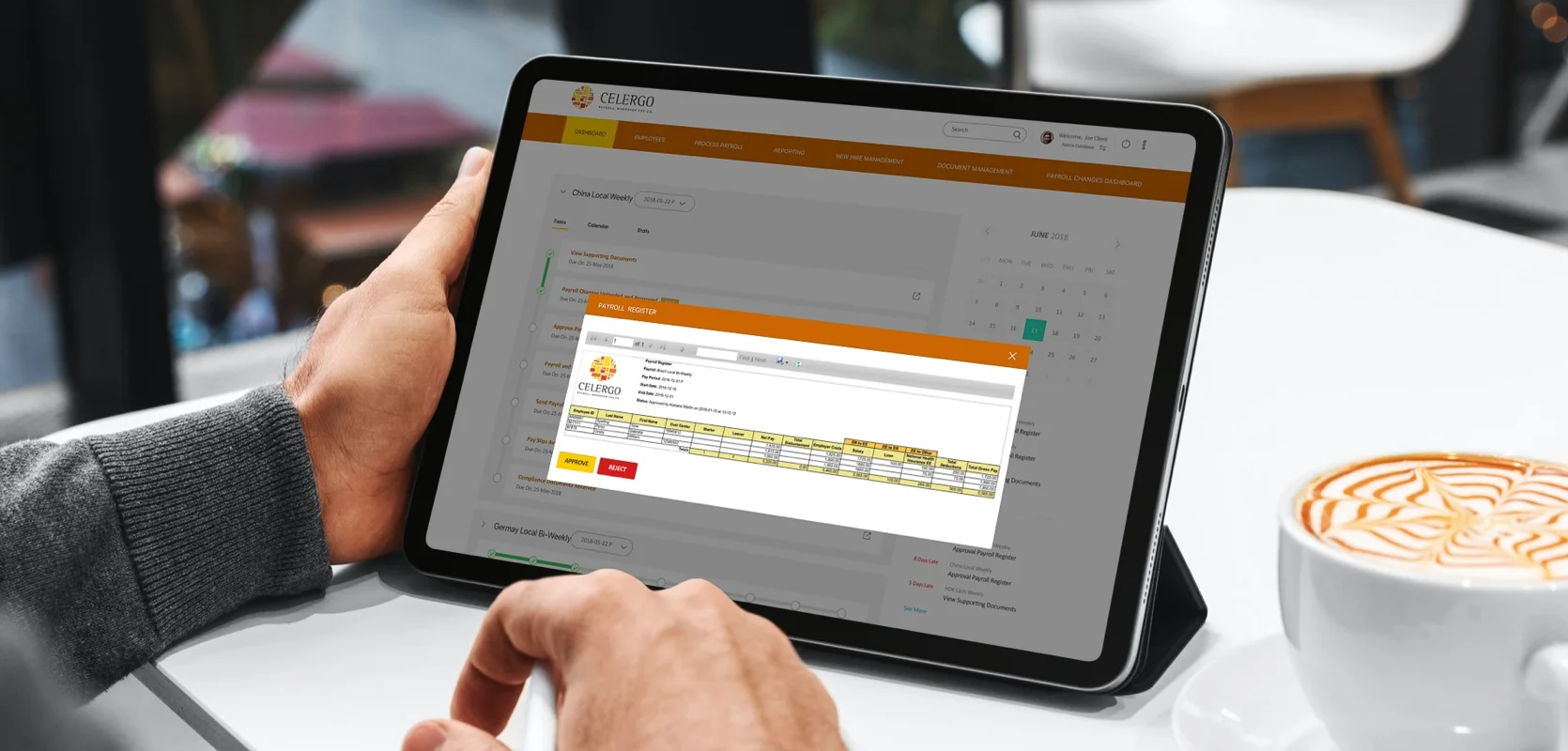
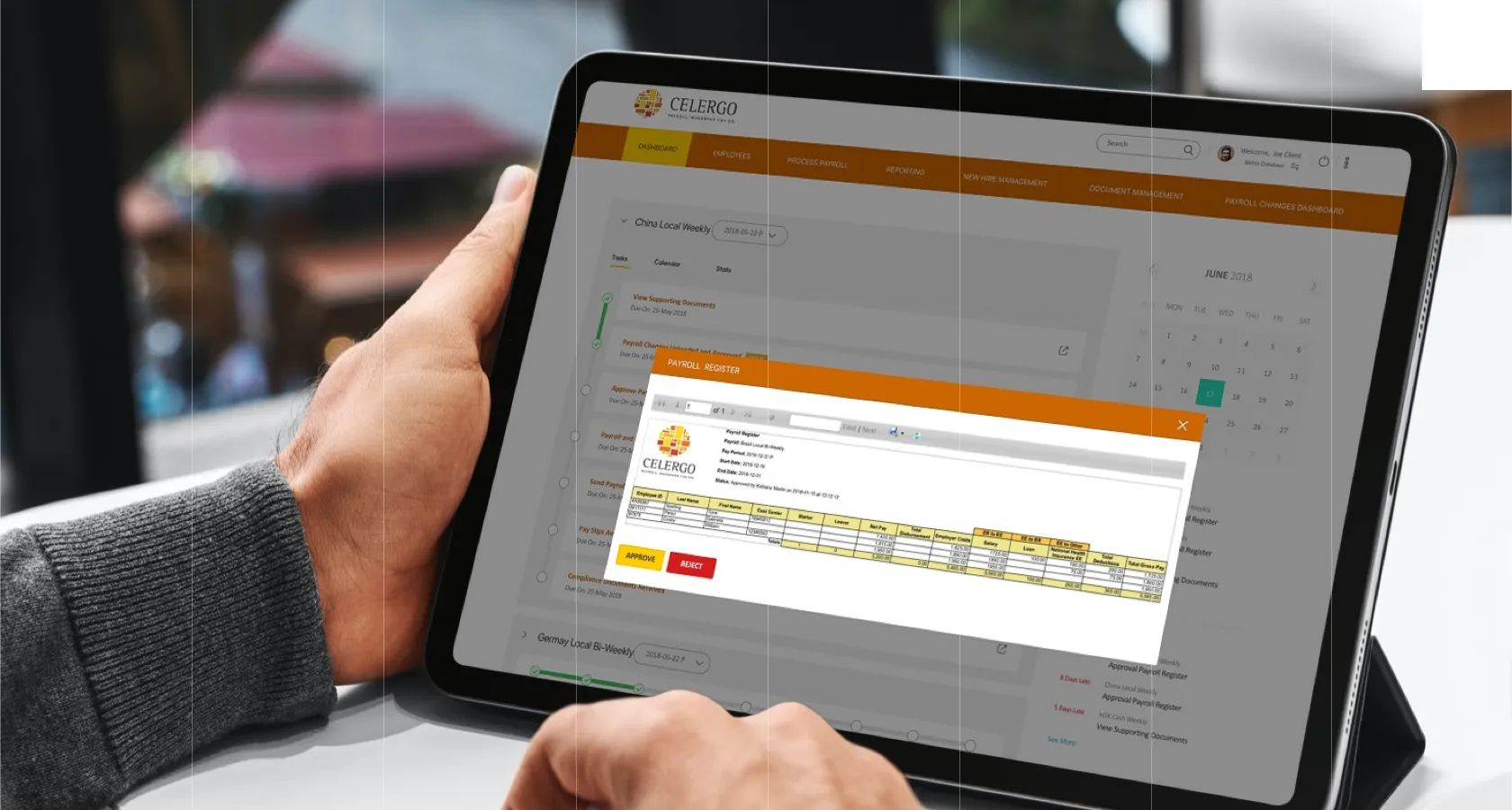
Celergo is a multi-country payroll technology provider, later acquired by ADP. Its platform handled payroll for thousands of employees across dozens of countries, each with its own language, currency and tax rules. The operational reality behind that scale was manual. Master payroll files ran to 400 pages, and pulling out one employee’s payslip meant paging through a consolidated document by hand. Every extraction carried a privacy risk, and every new country carried an engineering risk.
Over a partnership of more than six years, Net Solutions worked as an embedded part of Celergo’s engineering organisation while building a purpose-made automation platform alongside it. We engineered an asynchronous multilingual PDF slicing engine, wired Western Union cross-border payouts into the payroll pipeline, delivered around 150 SSRS reports at the database layer, and shipped a self-service portal for employees. Manual payslip extraction disappeared. Country launches stopped depending on custom code. Finance and HR teams got a single place to look.
When ADP completed the acquisition, we closed the engagement the way it had run: with a documented, structured handover to ADP’s internal engineering team and the successor vendor.
Celergo’s product worked. The operations around it did not scale at the same rate. Five bottlenecks kept surfacing.
Payroll output arrived as a single consolidated document covering an entire company, region or department. Isolating one employee’s payslip meant scrolling through hundreds of pages in a language the operator often did not read, then saving it manually to the right place. It was slow, it was error prone, and putting the whole organisation’s pay data in front of a person to find one record created a real privacy and compliance exposure.
Each market brought its own tax treatment, its own pay elements and its own payout frequencies. Encoding those differences in the core platform meant new-country onboarding competed with the product roadmap, and each addition risked destabilising logic that other countries depended on.
Cross-border salary disbursement was a separate workflow with its own steps and its own reconciliation. Payroll was calculated in one system and paid out through another, with a manual gap in between.
There was no centralised, queryable record of pay updates, element adjustments, payment logs and profile changes. Finance teams rebuilt the picture from scattered exports every cycle, which made audit trails a reconstruction exercise rather than a lookup.
Requests for a payslip from eighteen months ago, or a change of bank details, all landed on HR. Volume grew with headcount, and none of it required judgement.
We ran the engagement as two parallel workstreams rather than one with specialist engineers and DBAs embedded directly into Celergo’s internal teams that kept the core application roadmap moving. At the same time, a dedicated group built the high-throughput automation platform that the operational problems actually called for.
That split mattered. Keeping the lights on and building the fix are different jobs, and giving them separate teams meant neither one starved the other over six years.
Six components, built and released in sequence rather than as one delivery. The document engine came first because it removed the most immediate operational risk, and each later piece assumed the one before it. Everything sits inside Celergo’s existing stack, not beside it.
The measure of the work is what stopped happening. Manual extraction, custom code for every new market, spreadsheet reconciliation and routine HR requests each went away, and the platform kept running through an acquisition without losing what had been built.
Payslip extraction moved from a manual, page-by-page task to a background process. Documents reach the right employee in the right language without anyone opening the master file.
Onboarding a new country became a configuration and bulk-upload exercise. Growth no longer queued behind development capacity.
Around 150 reports replaced the spreadsheet exports that finance and account teams had been reconciling by hand, with the underlying data queried directly rather than copied.
Self-service access to historical payroll records took the highest-volume, lowest-value queries off the HR queue.
After the ADP acquisition, we executed a documented transition to ADP’s internal engineering team and the successor vendor, so six years of platform knowledge transferred cleanly.
Most partners do one of these two things. We do both at once.
Embedded staff augmentation gives a client sustained capacity inside their own teams, with engineers who learn the domain and stay long enough for that knowledge to compound. Platform engineering gives them net-new capability: document parsing engines, payment API integrations, reporting suites, portals. Run separately, the first becomes a staffing arrangement and the second becomes a project with an end date.
Run together, as they were at Celergo for more than six years, the same people who understand why the payroll logic works the way it does are the ones designing the automation around it. That is what removed structural operational risk here rather than simply adding headcount. And when the engagement reached its natural end, we closed it professionally, with documentation the incoming team could actually use.
Net Solutions built a global payroll automation platform for Celergo, a multi-country payroll technology provider acquired by ADP. The work included an asynchronous multilingual PDF slicing engine that extracts individual payslips from 400-page master payroll files, a bulk data ingestion pipeline for onboarding new countries, a Western Union integration for cross-border payouts, around 150 SSRS reports, a modernised Angular dashboard with global search, and a role-based employee self-service portal. The engagement ran for more than six years and combined embedded staff augmentation with custom platform engineering.
You automate payslip extraction by pairing a folder-monitoring scheduler with a parsing engine that recognises where one payslip ends and the next begins. At Celergo, the scheduler watched intake directories for newly uploaded master files, and a .NET / C# parsing engine identified individual payslip boundaries, extracted each record while preserving its native language formatting, and routed it into a hierarchy of Enterprise, Region, Department, Duration and User. Because the job runs asynchronously in the background, it can process a single month or a custom date range without slowing the live application.
Manual extraction is a compliance risk because it requires a person to open a document containing pay data for an entire company, region or department in order to retrieve one employee’s record. That exposes salary information for everyone in the file to whoever is doing the search, creates no reliable audit trail of what was viewed, and increases the chance that the wrong document is sent to the wrong person. Automated boundary detection and routing removes the human from the middle of the file entirely.
A payroll platform supports new countries without core code changes by treating country-specific rules as configuration rather than logic. For Celergo, we built a bulk data ingestion pipeline with a dynamic configuration layer, so localised pay elements, tax rules and payout schedules are defined as data. New markets, employee records, addresses and banking details are loaded in bulk, which means expansion no longer competes with the product roadmap or risks destabilising logic that existing countries rely on.
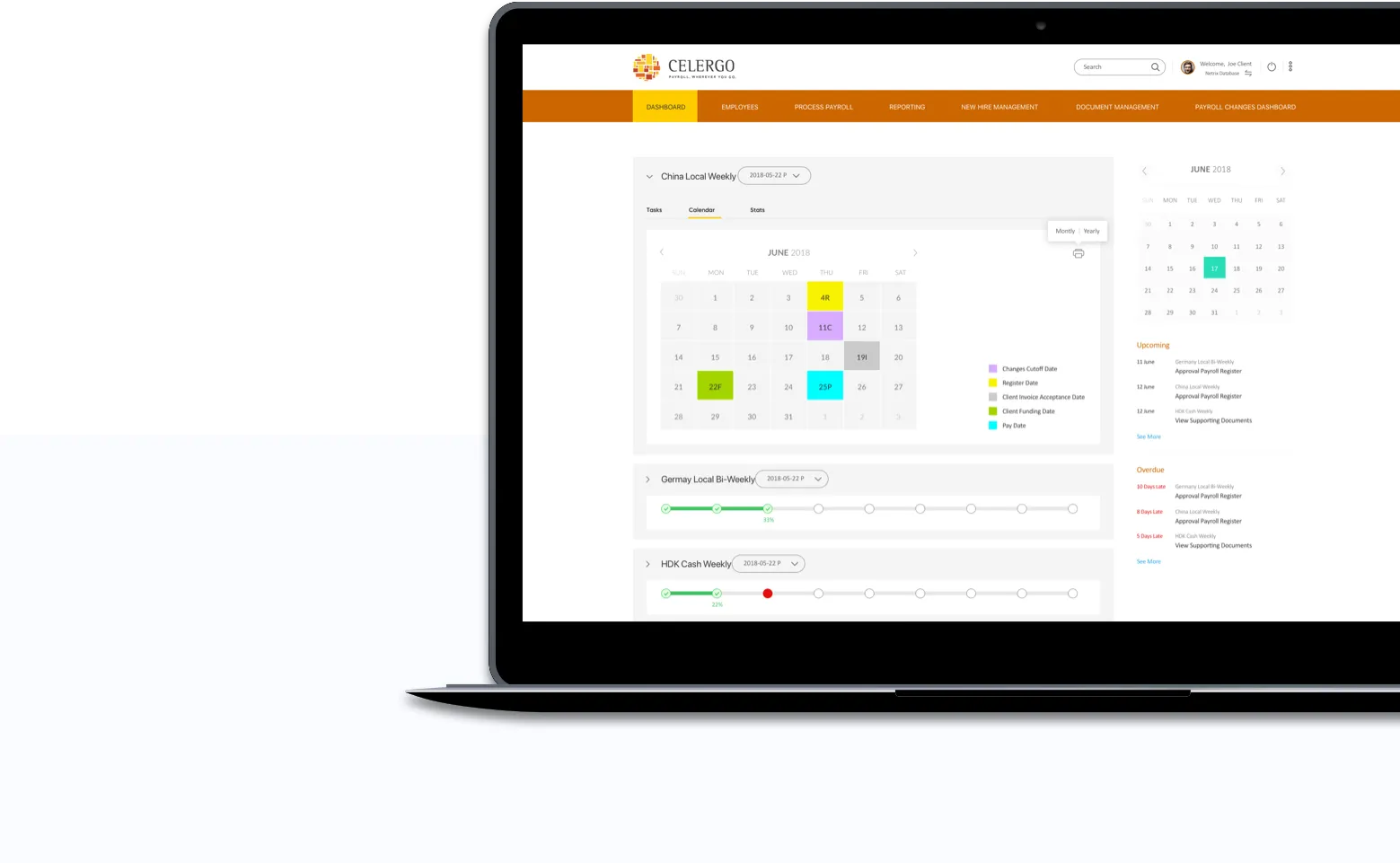
SSRS suits enterprise payroll reporting because it runs directly against the SQL Server database where payroll data already lives, so reports reflect the source rather than a copied extract. For Celergo we built around 150 SSRS reports covering pay updates, element adjustments, payment logs, profile changes and reconciliations, which gave Client Account Managers, In-Country Partners, finance and HR teams audit-ready visibility and replaced the spreadsheet exports they had been reconciling manually.
Cross-border payouts are integrated by calling the disbursement provider’s APIs from inside the payroll execution flow rather than running payment as a separate downstream process. At Celergo, Western Union disbursement APIs were embedded into the pipeline, with an automated validation step that checks calculation output before any payment is released. Calculation and payment then share one sequence, which removes the manual gap where reconciliation errors usually appear.
Embedded staff augmentation places specialist engineers inside a client’s existing teams, working on the client’s roadmap under the client’s priorities, rather than delivering a scoped project from the outside. At Celergo, SQL DBAs, .NET and C# developers, Dynamics CRM developers and Angular specialists embedded with internal teams to maintain the core application, while a parallel team built the new automation platform. The advantage is continuity: engineers accumulate domain knowledge over years, and the people who understand the existing system are the ones designing what gets added to it.
A well-run engagement ends with a structured handover rather than a sudden stop. When ADP acquired Celergo, Net Solutions carried out a planned, fully documented transition of the platform to ADP’s internal engineering team and the successor vendor, covering the automation platform, integrations and reporting suite built over six years. Planning the exit as a deliverable protects the client from knowledge loss at exactly the moment the system changes hands.
The Celergo engagement ran for more than six years. It began with embedded engineers supporting the core application roadmap, expanded into custom platform engineering covering document automation, payouts, reporting and self-service, and concluded with a documented handover following the ADP acquisition.
If your team is paging through documents, rebuilding reports in spreadsheets or writing custom code for every new market, there is usually an engineering answer. Tell us what the bottleneck looks like and we will tell you how we would approach it.
Results matter. Discover how our customized solutions have delivered measurable business outcomes for clients across various industries. Each case study highlights the strategic impact of our work, turning challenges into opportunities for growth.
Ask Sol anything about digital products, AI, engineering, or growth, and get answers drawn from years of Net Solutions thinking and experience.